

Chemical Peels
Licensed for use by Vital Glow
Functions of the skin
Protection - A barrier against physical trauma, chemicals, toxins and UV radiation.
Sensation - Contains receptors detecting touch, pain, pressure, heat and cold.
Secretion - Sebaceous glands secrete sebum (oil) to lubricate the skin and hair and waterproof the skin’s surface to form an ‘acid mantle’.
Excretion - Removal of waste through sweat glands to cool the body and remove toxins.
Absorption - Absorbs vitamins A, D, E and K, carbon dioxide and oxygen.
Diffusion - Movement of molecules from high to low concentration - exchange of gases (oxygen/CO2) to regulate internal balances.
Skin Structure
Epidermal Renewal Cycle
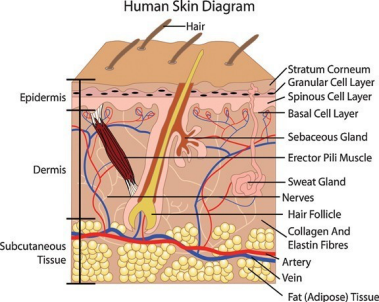
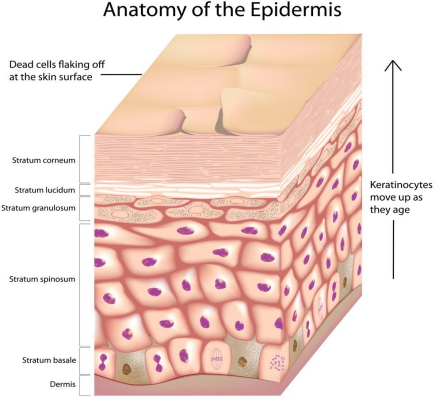
The epidermis is the outer layer, which undergoes constant renewal; every 28 days all cells are turned over as the most superficial cells are replaced by new ones. The turnover is much faster for infants and slows down over the course of our lifetime. The healing process also slows as we age.
What Is A Chemical Peel?
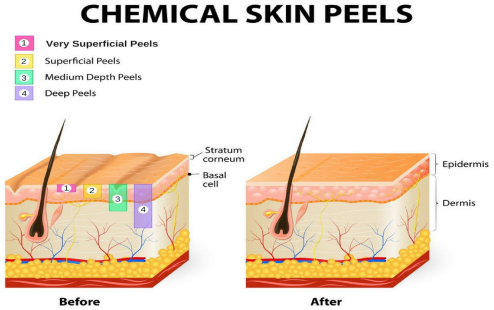
A chemical peel is a skin-resurfacing procedure. Depending on the issues you're addressing with the procedure, you'll choose a chemical peel in one of three depths:
Light chemical peel
A light (superficial) chemical peel removes the outer layer of skin (epidermis). It's used to treat fine wrinkles, acne, uneven skin tone and dryness. You might have a light peel every two to five weeks.
Medium chemical peel
A medium chemical peel removes skin cells from the epidermis and from portions of the upper part of your middle layer of skin (dermis). It's used to treat wrinkles, acne scars and uneven skin tone. You might need to repeat the procedure to achieve or maintain the desired result.
Deep chemical peel
A deep chemical peel removes skin cells even deeper. You might recommend one for deeper wrinkles, scars or pre-cancerous growths. You won't need repeat procedures to get the full effect.
What Do Chemical Peels Do?
Chemical peels are cosmetic treatments that can be applied to the face, hands, and
neck. They’re used to improve the appearance of the skin. During this procedure,
chemical solutions will be applied to the area being treated, which causes the skin
to exfoliate and eventually peel off. Once this happens, the new skin underneath is
often smoother, appears less wrinkled, and may have less damage.
There are a number of reasons people may get chemical peels. They may be trying
to treat a variety of things, including:
- Wrinkles and fine lines.
- Sun damage.
- Acne scars.
- Hyperpigmentation including melasma.
- Uneven skin tone or redness.
Penetration Levels
Benefits Of Glycolic Acid
- Powerful exfoliation
- Brightens and evens skin tone
- Anti-ageing and collagen support
- Acne prevention
- Boosts hydration
Benefits Of Salicylic Acid
- Deep pore cleansing
- Acne treatment & prevention - kills bacteria
- Effective exfoliation
- Reduces inflammation
- Reduces excess oil
Benefits Of Azelaic Acid
- Reduces acne - kills bacteria and reduces inflammation
- Reduces redness and rosacea
- Improves skin texture
- Effectively treats post-inflammatory hyperpigmentation (PIH)
- Well tolerated even for sensitive skin types
Benefits Of Lactic Acid
- Breaks down dead skin cells
- Hydration boost - retains moisture in the skin
- Stimulates ceramide production to strengthen skins barrier
- Reduces Keratosis Pilaris - small rough bumps (chicken skin)
- Reduces appearance of rough texture, fine lines and wrinkles
Benefits Of Mandalic Acid
- Gentle exfoliation - large molecule size penetrating the skin slowly
- Fades hyperpigmentation
- Suitable for all skin tones - less likely to cause irritation
- Stimulates collagen production
- Unclogs pores
Benefits Of Kojic Acid
- Fades acne scarring (post-inflammatory hyperpigmentation/PIH)
- Promotes a brighter, more radiant complexion
- Targets the source of pigmentation - highly effective for fading sun damage
- Antioxidant properties protecting skin from environmental stresses
- Improves skin texture
Benefits Of Tranexamic Acid
- Targets pigmentation - preventing the overproduction of melanin
- Improves skin barrier
- Skin brightening agent
- Anti-inflammatory action, reducing post breakout marks
- Can be used on sensitive skin
What To Expect After A Chemical Peel
- After a chemical peel, your skin will likely be red and dry. You may also experience some itchiness, swelling, and discomfort. A deeper peel may even cause your eyelids to swell.
- When the peel is finished, your skin will take a few days to peel off and reveal a fresh new layer. Typically, the peeling doesn’t start until about the third day.
- The intensity of the effects of your chemical peel will vary depending on the type of peel you received.
- The deeper the peel, the longer it will take for your skin to peel off and begin recuperating.
Contraindications
Contraindications to chemical peels must always be discussed with your patient.
- Use of Accutane®, Retin-A®, or other medications that exfoliate or thin the skin within 12 months.
- Recent cosmetic surgery, laser resurfacing, deep or medium depth chemical peels or dermabrasion.
- Severe rosacea or acne.
- Pregnancy or Breast-feeding.
- Sunburn or irritated skin.
- Open sores or lesions.
- Infectious disease.
- Active Herpes simplex.
- Diabetes.
- Heart disease.
After Care
- Don’t touch your skin and keep hair off your face.
- Keep the skin hydrated.
- Use SPF 50+ daily.
- Ensure pillowcase, towels and make-up brushes are clean.
- Do not pull, pick or scratch the skin.
- Avoid heat including hot showers, saunas and steam rooms.
- Avoid vigorous exercise.
- Avoid active products for 5 days following the treatment (AHA/BHA, retinol, vit c etc).
How Often Should A Chemical Peel Be Performed?
It is generally advised to get a chemical peel every four to six weeks. However, if your patient suffers from acne, there are some peels that you can do every two weeks until you find the expected results. Most patients buy a series of four or five peels up front to achieve the treatment results wanted.
How Long Do Results Last?
- A light chemical peel improves skin texture and tone and lessens the appearance of fine wrinkles. The results are subtle but increase with repeated treatments.
- If you have a medium chemical peel, treated skin will be noticeably smoother.
- After a deep chemical peel, you'll see a dramatic improvement in the look and feel of treated areas. Results may not be permanent. Over time, age and new sun damage can lead to new lines and skin colour changes.
- With all peels, the new skin is temporarily more sensitive to the sun.
- You can expect results to last between 2-6 months
FAQs
What should I expect during treatment?
Procedures may vary depending on the type of chemical peel chosen. Skin is prepped using a medical degreaser to ensure the treated area is free of any oils left on the skin. The chemical agent is then applied and typically remains on the skin for 3 to 5 minutes. Most patients feel a mild stinging which is temporary and usually subsides after a few minutes. Some peels are designed to self-neutralize and may remain on your skin for 2-4 hours. (home peels)
How long is the recovery after a chemical peel and what type of care is necessary?
Recovery times will vary based on the type and strength of the peel. Immediately after the peel, your skin will feel tight and may be red. Any visible peeling will be light and fluffy and easily controlled with moisturizer. Peeling usually lasts 3-5 days, depending on the actual peel treatment. Use of gentle cleanser, moisturizer and sunscreen is important, as it will enhance the healing process and results. Normal activity may be resumed after the peel, however strenuous exercise and heavy sweating should be avoided for 2-3 days.
Sun exposure should be avoided while skin is peeling; exposure of treated skin to a lot of heat should also be avoided as it may induce swelling, redness and for deeper peels blisters under the skin. Peeling skin should be allowed to slough off naturally; picking or peeling of flaking skin is prohibited, as it may lead to scarring. Use of prescription topicals should be avoided for 3-5 days post peel.
Why did I not have any visible peeling after my peel?
The success of the peel should not be judged by the amount of peeling, but by the end results that the peel will produce. The amount of peeling may vary depending on individual skin condition at the time of the peel or the depth of the peel. Regardless of the degree of peeling, the skin is still sloughing off at an accelerated rate, resulting in the improvement of skin tone and texture and an improvement of fine lines and uneven pigmentation.
What products or procedures should I avoid before a chemical peel?
One week before the peel avoid waxing, electrolysis and laser hair removal. Two to three days before the peel discontinue using any prescription topicals such as RetinA, differin or Tazorac, as well as any products containing retinol, alpha hydroxyl acids (AHA), beta hydroxyl acids (BHA) or benzoyl peroxide. Patients who have had any medical cosmetic facial treatments or procedures such as Laser treatments, cosmetic fillers or other surgical procedures should wait until skin sensitivity has completely resolved before receiving a peel.
What can I expect after the 1st 24 hours after the peel?
Your skin will feel tighter and be more red than usual. Your skin may feel tacky and have a yellowish orange tinge that subsides in a few hours. This is due to the Retinoic acid applied to the skin. This is a self-neutralizing peel and patients should wait at least 4 hours before washing their face that evening.
When will my skin start to peel and for how long?
Peeling will generally start 48-72 hours after your treatment and can last 2-5 days. It is very important not to pick off peeling skin; peeling is minimal and easily controlled with moisturizer. Premature peeling of the skin will result in dry, cracked, raw skin that may develop into hyperpigmentation.
How do I care for my skin after the peel?
Use a gentle cleanser to wash your face, exfoliators and wash cloths should be avoided while skin is peeling. Application of a hydrating moisturizer twice a day or as often as necessary is recommended to relieve dryness and control peeling. A physical Sunblock must be worn daily. It's best to avoid prolonged sun exposure for 1-week post peel.
Book your consultation
Clinic Appointments
Solihull, West Midlands.
Private Mobile Treatments
Available across the Midlands for home, office, or hotel visits.
Coming Soon
Wider UK coverage as Vital Glow expands.